Other Financial Reports
The Other Financial Reports is a section on the Financial Report Directory that contains reports designed for distributed users that are independent of the other financial dashboards.
| Select this link... | ...for reports about |
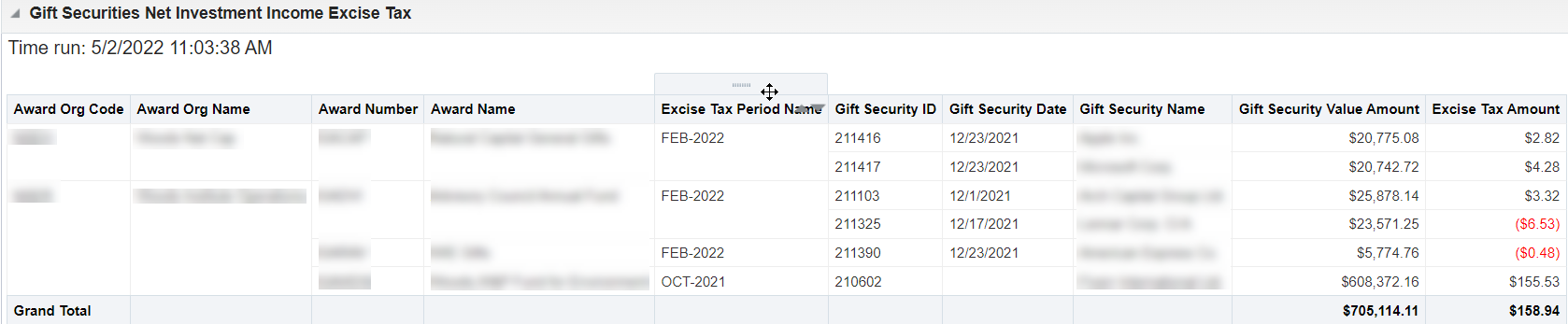
| Gift Securities Net Investment Income Excise Tax | Detail of the 1.4% excise tax levied on the capital gains of stock donations derived from Stanford’s GRASP (Gift Record and Security Proceeds) system recorded in the TCJA (Tax Cuts & Jobs Act) system. |
Gift Securities Net Investment Income Excise Tax
The Gift Securities Net Investment Income (NII) Excise Tax report, intended for school and unit budget officers and financial analysts, provides detail of the 1.4% excise tax levied on the capital gains of stock donations received by funds. The report pulls data from GRASP (Gift Record and Security Proceeds), Stanford’s system for recording and tracking the donations and proceeds of gift security/stock donations. Refer to Topic Overview: Donor Gifts.
Sample Business Questions
- Which securities were donated and sold , and then added as revenue to my fund(s)?
- What is the excise tax amount for any stock donations and/or dividend income charged to my fund/organization/unit by GL Period?
- When was the security originally transferred to the University and what is the gift security ID number?
Selection Criteria
To retrieve results, follow the Selection Criteria instructions near the top of the screen. Refer to Using Selection Criteria for OBI Reports for more guidance.
- Refer to Understanding the Data below for clarification on excise tax period posting during the processing of securities.
Data is not available prior to FY22.
Report Views
- The posting of gift securities revenue to a fund and when the excise tax is posted, may be in different GL periods. Excise Tax Period is the GL period the excise tax posts to the fund. It will generally be the same period that the gift is posted as revenue but may be a month or two later in some circumstances.
- Due to stock price valuation swings between receiving and selling the stock, Excise Tax Amount may be positive or negative. An increase in stock value will create a negative excise tax posting amount.
- Effective FY24, for gift values of less than $500,000, monthly net investment income excise tax charges will be posted to a central office general fund. For gifts with a value of $500,000 or greater, the excise tax charges will continue to be charged to the award allocation. For more information, refer to Topic Overview: Donor Gifts - Managing Donor Gifts.
Understanding the Data
Fund Statement Display of Excise Tax Transactions
On the Fund Statement, excise tax is displayed as a single aggregated amount for each GL period for that award, even though the gifts are listed in the Excise Tax report separately with distinct Gift Security IDs. The revenue by contrast is posted in Fund Statement with one line for each Gift Security ID number and the Journal Line Descriptive Text begins with the Gift Security ID number followed by the donor name, not the Gift Security Name.
- Excise tax will appear on the Fund Statement under the object code
- 47415-INVEST EXCISE TAX-REALZD GAINS.
- Two additional offsetting transactions (one negative and one positive) will appear on the Fund Statement to facilitate posting to the proper accounts:
- 47299-INV EXP NETASSET ALLOC
- 47310-OTHER INVEST EXPENSE - EXPEND (for gifts)
- 47305-OTHER INVEST EXPENSE - ENDOW (for endowments)
For donor advised endowment funds the excise tax will post to the EN journal ledger code. For all others it will post to the SU journal ledger code.